Guide
How Freelancers Should Price Work in the AI Era
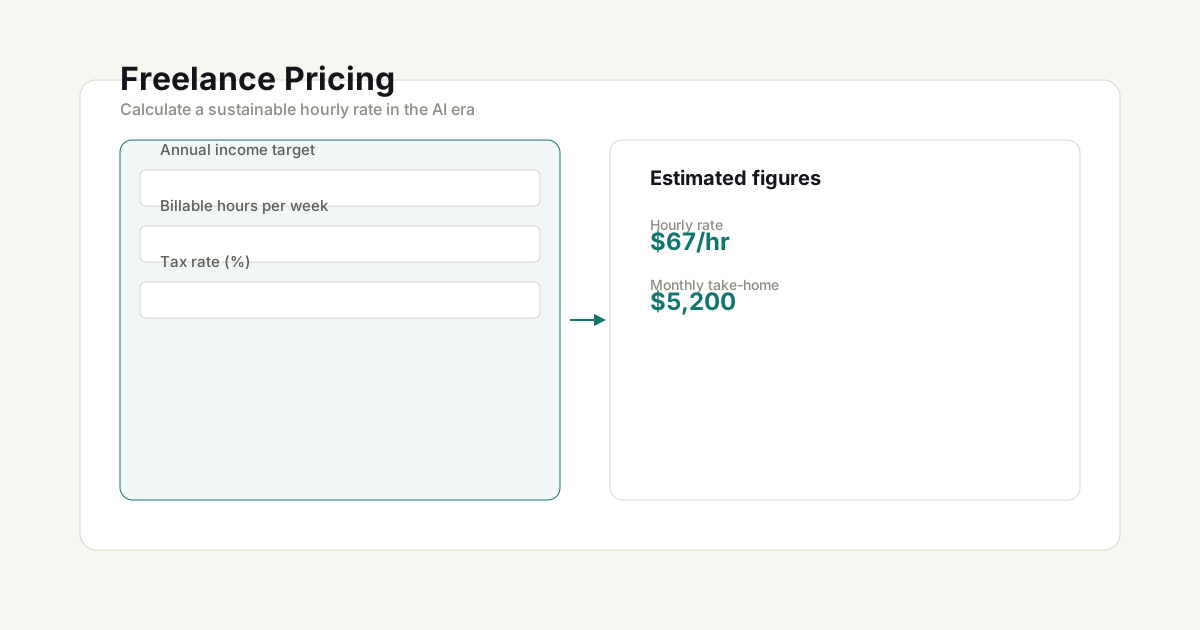
Clients know AI tools speed things up. They’re asking about discounts. Here’s how to defend your rates — and when to offer a deal that actually works for you.
The problem AI created for freelancers
The headline is hard to argue with: “If AI cuts your writing time from 4 hours to 30 minutes, why should the client still pay the same rate?”
The answer is that value pricing and hourly pricing are not the same thing. But if you’re billing by the hour, you have a problem.
Three pricing strategies for the AI era
1. Value-based pricing (best option)
Price based on the outcome, not the time spent. A blog post that ranks #1 on Google, generates leads, and builds authority is worth the same whether you wrote it in 4 hours or with AI help in 30 minutes.
How to do it:
- Price projects as a package, not by the hour
- Tie pricing to business outcomes where possible
- Be transparent: “My process uses the best tools for each job. The deliverable is what matters.”
2. Blended hourly rate (transition option)
If clients insist on hourly billing, adjust your rate to reflect the value of your expertise, not your typing speed.
Your new rate should include:
- Domain knowledge — you know what good looks like
- Quality control — you edit and verify AI output
- Strategic input — you know the right questions to ask
- Liability — if the work fails, the client comes to you, not the AI
A reasonable starting point: 2–3× your pre-AI hourly rate if you’re using AI to deliver faster, not cheaper.
3. Tiered pricing (for skeptical clients)
Offer options that let clients choose their level of involvement:
| Tier | Price | What they get |
|---|---|---|
| Standard | Your normal rate | Full service using the best tools available |
| Premium | 1.5× normal | Human-only process, full transparency on methods |
| Self-serve | Discounted | AI-only output with minimal review (not recommended unless it’s truly commodity work) |
Use the Freelance Hourly Rate Calculator to make sure even your lowest tier covers your tax, expenses, and time off.
The one number you must know
After taxes, business expenses, unpaid admin, and time off, your true hourly rate is likely 50–70% higher than the “salary equivalent” you’re thinking of.
A $100,000 salary target as a freelancer typically means billing around $75–$85/hour after all deductions. AI doesn’t change that math — your costs haven’t gone down.
When to offer an AI discount
Sometimes it makes strategic sense:
- Client’s first AI-collaboration project — you’re establishing a relationship
- High-volume, low-complexity work — they can find alternatives easily
- Long-term retainers — a small discount for guaranteed monthly income
Never discount for:
- Clients who just read a sensational article about “AI replacing freelancers”
- One-off projects where you do most of the value work
- Work where your expertise, not speed, is the deliverable
→ Use the Freelance Hourly Rate Calculator to find a rate that keeps you sustainable — with or without AI in your workflow.
Frequently Asked Questions
Should I charge less because AI makes me faster?
No — AI-driven speed increases your effective hourly rate, but your value to the client hasn't decreased. Charge based on the outcome you deliver, not the minutes you spend. In fact, many freelancers raise rates when they can deliver higher-quality work faster.
How do I explain AI-accelerated pricing to clients?
You don't need to justify how you achieve speed. Clients pay for results — a delivered project, not a timesheet. Frame your pricing around the value of the final deliverable. If asked, say you use modern workflow tools without getting into specifics.
What's the difference between hourly and project pricing in the AI era?
Hourly pricing penalizes you for efficiency — the faster AI makes you, the less you earn. Project or value-based pricing fixes this: you capture the upside of AI speed while the client gets faster delivery. This is the single biggest pricing shift AI enables for freelancers.
Planning tools — Use the calculators and frameworks on this site to model scenarios and compare assumptions. Results are estimates, not financial, legal, or tax advice.