Guide
How to Estimate LLM API and Token Costs
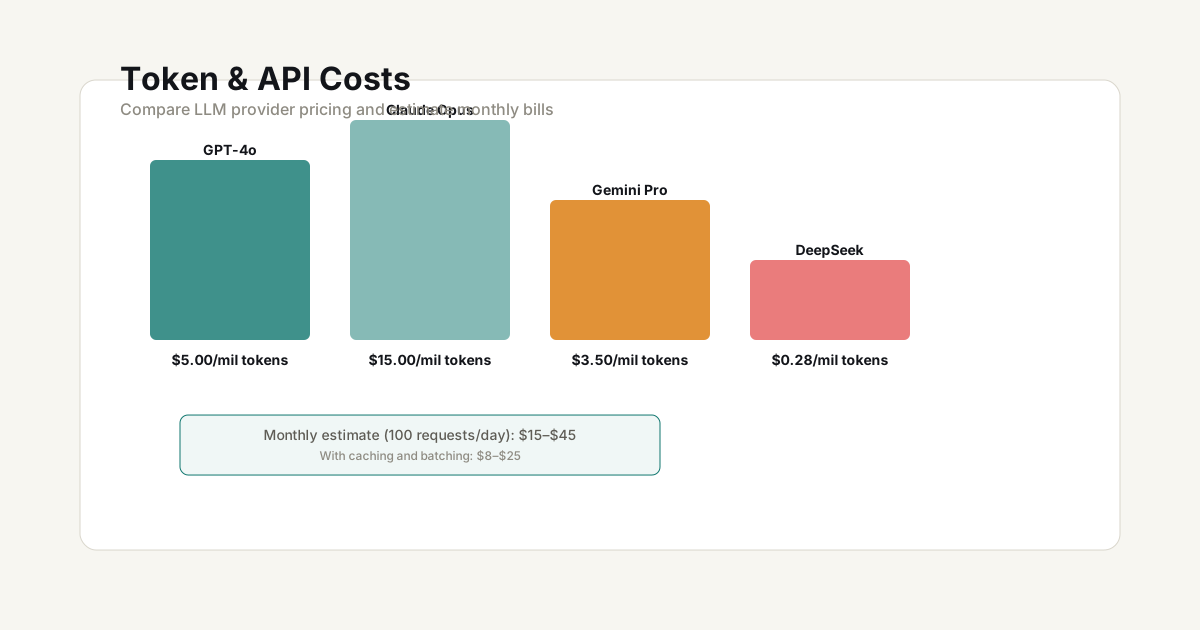
If you’re building with AI APIs, your monthly bill can range from a few dollars to thousands depending on your provider, model choice, and usage patterns. Here’s how to estimate costs before you build.
How token pricing works
LLM providers charge per token — roughly 0.75 words for English text. Every API call has two components:
- Input tokens — The prompt, system instructions, conversation history, and any uploaded documents
- Output tokens — The generated response
Input tokens cost 3–5x less than output tokens because generating text requires more compute. A typical pricing breakdown:
| Provider | Input price per M tokens | Output price per M tokens |
|---|---|---|
| GPT-4o | $2.50 | $10.00 |
| Claude Sonnet 4.6 | $3.00 | $15.00 |
| Gemini 2.5 Pro | $1.25 | $5.00 |
| DeepSeek V3 | $0.27 | $1.10 |
Estimating your usage
The biggest mistake is underestimating how many tokens you’ll use, especially for input. A single chat session can easily consume 10,000–50,000 input tokens in context alone.
Realistic estimates by use case:
| Use case | Avg tokens per call | Daily calls |
|---|---|---|
| Simple Q&A chatbot | 500–1,000 | 500–5,000 |
| Customer support assistant | 2,000–4,000 | 200–1,000 |
| Content generation | 4,000–8,000 | 20–100 |
| Document analysis | 15,000–30,000 | 10–50 |
Use the Token Cost Calculator to compare providers side by side with your actual token estimates.
Subscription vs pay-as-you-go
Some AI providers offer flat-rate subscription plans that include a set number of API calls. These can be cheaper if your usage fits within the included allotment. The decision comes down to:
- If you use less than 60% of the included calls, pay-as-you-go is probably cheaper
- If you use more than 80%, the subscription is likely better value
- If usage fluctuates heavily (some months 10K calls, others 100K), pay-as-you-go is safer
Compare billing models: API Cost Calculator shows whether a flat subscription or per-token pricing is cheaper for your volume.
Hidden costs to watch for
- Context caching — Repeated system prompts add up fast. Use prompt caching (available on Anthropic and some OpenAI plans) to cut input costs by up to 50%
- Retries and errors — Failed API calls still consume tokens
- Testing and iteration — Development cycles can consume significant tokens that aren’t “wasted” but do add cost
- Output length — Reviews are cheaper than long reports. Control max tokens in your API calls
Choosing a provider
There’s no universal cheapest provider — it depends on your usage pattern:
- Chat-heavy workloads — GPT-4o is competitive on speed and cost
- Long document work — Claude’s 200K context and caching can be cheaper overall
- High volume, simple tasks — DeepSeek V3 or Gemini 2.5 Pro offer the lowest per-token prices
- Mixed workloads — Consider using multiple providers routed by task type
Run the comparison: Token Cost Calculator and API Cost Calculator to find the most cost-effective setup.
Frequently Asked Questions
What's the difference between tokens and words?
A token is roughly 0.75 words in English — so 1,000 tokens ≈ 750 words. LLMs charge per token for both input (your prompt) and output (the response). Output tokens usually cost 3-5x more than input tokens, so optimizing prompt length has less impact than controlling response length.
How do I estimate costs before building?
Use the LLM API Cost Calculator to model your expected usage. Estimate tokens per request × requests per day × 30 days. Start with a small-scale test (100 requests) to get real numbers, then extrapolate. Most projects overestimate by 2-3x in the planning phase.
Which LLM provider is cheapest for my use case?
For high-volume simple tasks, GPT-4o mini and Claude Haiku are the most cost-effective. For complex reasoning, GPT-4o or Claude Sonnet are worth the premium. Gemini Flash offers competitive pricing with Google ecosystem integration. Compare pricing per 1M tokens, not per request.
Planning tools — Use the calculators and frameworks on this site to model scenarios and compare assumptions. Results are estimates, not financial, legal, or tax advice.