Guide
How to Price and Profit from Digital Products
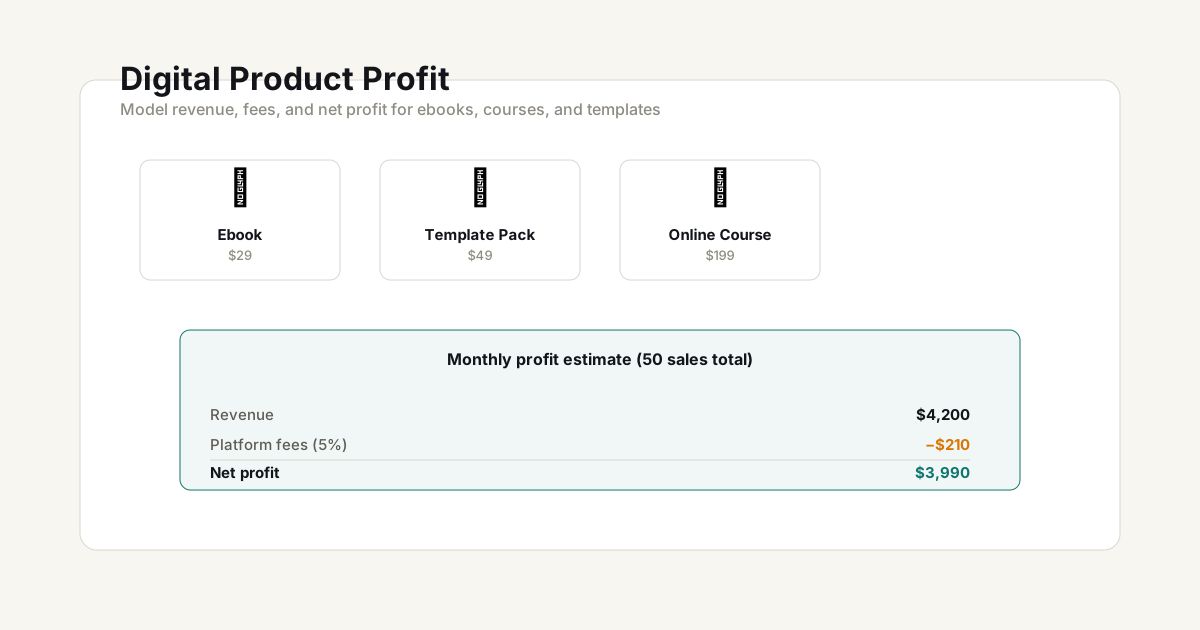
Digital products are the best margin business a creator can build — no inventory, no shipping, nearly zero marginal cost per sale. But pricing, platform fees, refunds, and marketing costs eat into profit faster than most people expect. Here’s the math to get it right before you build.
Why digital products are different
Unlike services (where you trade time for money) or ads (where platforms control the payout), digital products have a nearly 100% gross margin once created. A $97 course costs roughly the same to deliver whether you sell 10 copies or 1,000.
But that math also means pricing mistakes compound. Overprice and nobody buys. Underprice and you can’t cover your production costs.
Three pricing models
1. Cost-plus pricing (don’t do this for digital)
Cost-plus means adding a margin on top of your costs. It works for physical goods but makes no sense for digital — the marginal cost of delivery is near zero.
2. Competitor pricing (starting point only)
Look at what similar products charge: ebooks on Gumroad average $10–$30, templates $20–$80, online courses $50–$500, and premium cohort-based programs $1,000+.
Competitor pricing gives you a range. But it doesn’t tell you whether your product justifies the price.
3. Value-based pricing (the right approach)
Price based on the outcome your product delivers:
- “This Notion template saves 5 hours of setup at $75/hour = $375 in value. Charge $49.”
- “This course teaches a skill that can add $10,000/year in freelance income. Charge $197.”
Price should be 10%–30% of the value delivered. If the value is clear, the price feels cheap. If it’s vague, any price feels too high.
→ Use the Profit Margin Calculator to model margin, markup, and break-even for any price you’re considering.
Platform choice matters more than you think
Each platform takes a different cut. The gap between the best and worst can be 60%+ of your revenue.
| Platform | Fee | Best for |
|---|---|---|
| Gumroad | 10% flat + 2.9% + $0.30 | Ebooks, templates, small digital goods |
| Fourthwall | 3% + 2.9% + $0.30 | Memberships + digital products |
| Teachable Basic | $39/month + 5% + 2.9% + $0.30 | Courses at volume |
| Udemy | 63% (or 97% if you bring the customer) | Discovery, but low margin |
| Kajabi | $119–$319/month + 0% | All-in-one with email marketing |
| Self-hosted (Stripe + site) | 2.9% + $0.30 | Maximum margin, requires your own traffic |
At 100 sales of a $97 course:
- Gumroad: ~$8,540 take-home
- Teachable: ~$8,250 (plus $39/month platform fee)
- Udemy (organic): ~$3,590
- Self-hosted: ~$9,390
→ Use the Digital Product Profit Calculator to compare your actual price and expected sales across platforms.
The break-even calculation you need before building
Break-even tells you how many sales you need to recover your costs:
Break-even sales = (production cost + marketing cost) ÷ (price − fees per sale)
If a course costs $3,000 to produce, you spend $1,000 on launch marketing, and your net per sale after fees is $68 on a $97 course:
($3,000 + $1,000) ÷ $68 = 59 sales to break even
If you project 50 sales per month, you’re profitable in month 2. If you project 15, it takes 4 months. Know this number before you film.
→ Use the Course Revenue Calculator to model break-even, monthly profit, and annual revenue with your own numbers.
The refund rate reality
Digital products have higher refund rates than physical ones. Buyers can’t “hold” an ebook before buying, and courses often don’t meet inflated expectations.
Typical refund rates:
- Ebooks and templates: 2%–5%
- Online courses: 5%–10%
- Saas-like monthly products: 3%–8% (but churn matters more than refunds)
The biggest driver of refunds: overpromising. A course titled “Master Python in 30 Days” will have higher refunds than “Python Fundamentals for Beginners” — even if the content is identical. Set expectations accurately.
How profitable should a digital product be?
Healthy benchmarks for solo creators:
| Metric | Healthy | Excellent | Concerning |
|---|---|---|---|
| Gross margin | 70%+ | 90%+ | Below 60% |
| Net margin | 20%+ | 40%+ | Below 10% |
| Break-even | Under 3 months | Under 1 month | Over 6 months |
Gross margin should be high — digital delivery costs pennies. If it’s not, your platform is taking too much. Net margin includes marketing, which can be dialed up or down. Breaking even in under 3 months means the product has legs.
→ Use the Profit Margin Calculator to benchmark your actual numbers against these targets.
The pre-launch checklist
Before you create anything, run these numbers:
- Set a price based on value, not cost
- Model platform fees for at least two platforms
- Calculate break-even sales (production + marketing ÷ net per sale)
- Estimate realistic monthly sales (conservative, not aspirational)
- Check that profit margin exceeds 20% net at the projected volume
- If any number looks thin, adjust price or platform before you invest time
Frequently Asked Questions
How do I price my first digital product?
Start with the 10x rule: price at roughly 10x the monthly value the product delivers. A template that saves 2 hours/month at $50/hour is worth $100+ per year, so $25-50 is reasonable. You can always raise prices later — it's much harder to lower them.
What's a good profit margin for digital products?
Digital products have inherently high margins because there's no per-unit cost. After platform fees (typically 5-10%), you should see 85-95% margins. The main cost is your time creating the product, which is fixed whether you sell 10 or 1,000 copies.
Which platform takes the lowest fees?
Gumroad charges 10% on the free plan, 0% + payment processing on the $10/month plan. Payhip charges 5% on the free plan. Lemon Squeezy charges 5% + $0.50 per transaction. Self-hosted options like WooCommerce only have payment processor fees (2.9% + $0.30).
Planning tools — Use the calculators and frameworks on this site to model scenarios and compare assumptions. Results are estimates, not financial, legal, or tax advice.