Guide
How to Build and Measure a Sales Funnel
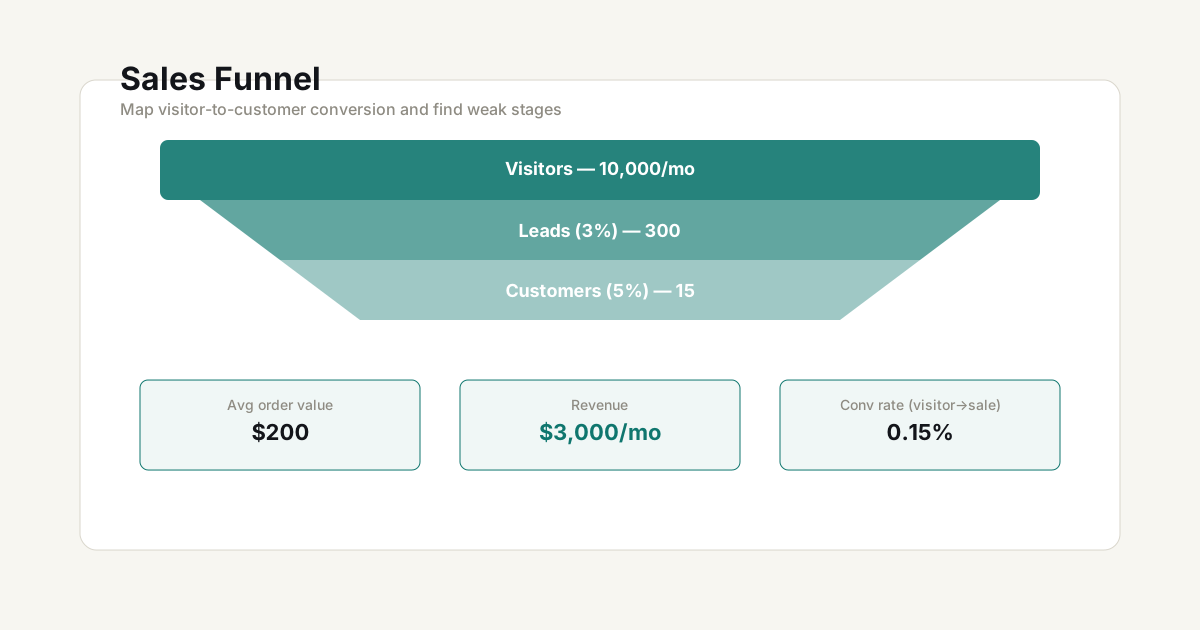
A sales funnel sounds complicated, but it’s just a series of steps a visitor takes before becoming a customer. The magic is in measuring each step so you know exactly where to focus your energy.
The basic funnel stages
Most creator and solo business funnels look something like this:
Visitors → Opt-ins → Email clicks → Checkout → Customers
Each stage has a conversion rate, and the product of all stages gives you your end-to-end rate. A typical funnel might look like:
| Stage | Volume | Conversion |
|---|---|---|
| Monthly visitors | 10,000 | — |
| Opt-in rate | 1,500 | 15% |
| Email click rate | 450 | 30% |
| Checkout conversion | 36 | 8% |
| Customers | 36 | 0.36% end-to-end |
Where to focus
The most common mistake is trying to fix everything at once. Instead, identify the weakest stage — the one with the biggest gap between current and achievable performance.
Which metric to improve for the biggest impact:
- If visitors are low under 5K/month — Focus on content marketing and SEO to grow traffic
- If opt-in rate is under 10% — Improve your lead magnet or landing page
- If email click rate is under 20% — Work on subject lines and email copy
- If checkout conversion is under 5% — Simplify the checkout process, add testimonials
- If AOV is under your target — Add upsells, bundles, or higher-tier options
Model your full funnel: Funnel Revenue Calculator shows revenue and profit across all stages.
Using lead magnets to grow the top of funnel
Lead magnets (free ebooks, templates, checklists) are the most effective way to grow your email list and move visitors into your funnel. The key metrics:
- A good lead magnet converts 20–35% of visitors to email subscribers
- The lifetime value of that subscriber depends on your product and follow-up sequence
- Even a small lead magnet can pay for itself if 2–5% of subscribers eventually buy
Use the Lead Magnet Value Calculator to estimate how much a free download is worth over a year.
Affiliate commissions as a funnel output
If you recommend products as part of your content, the commission calculator helps you model how traffic and conversion affect affiliate income:
The Affiliate Commission Calculator shows how visitors, click-through, and conversion rates determine your monthly commissions.
Funnel profitability
Revenue is only half the picture. You need to subtract traffic costs (ads, content production, tools) and fixed costs (landing page, email platform). A profitable funnel has:
- Revenue > (traffic cost + fixed costs)
- Customer acquisition cost < customer lifetime value
- Room to scale — can you increase traffic without destroying conversion rates?
Build the full picture: Funnel Revenue Calculator with traffic costs, Lead Magnet Value Calculator, and Affiliate Commission Calculator.
Frequently Asked Questions
What's a realistic conversion rate at each funnel stage?
Visitor-to-lead typically ranges 1-5%, lead-to-trial 5-20%, and trial-to-customer 15-30%. These vary widely by industry and traffic quality. Start by measuring your own baseline before comparing to benchmarks — your first goal is improving your own numbers month over month.
Do I need paid ads to build a funnel?
No — many successful solo business funnels run entirely on organic content, SEO, and word of mouth. Paid ads accelerate the model once you've proven it works organically and you know your customer acquisition cost. Start free, then scale with ads.
How long before I see results from a sales funnel?
A new funnel typically takes 3-6 months to produce consistent data. The first 90 days are about building traffic and testing messaging. Don't optimize too early — you need at least 100 conversions per stage before the numbers become statistically meaningful.
Planning tools — Use the calculators and frameworks on this site to model scenarios and compare assumptions. Results are estimates, not financial, legal, or tax advice.