Guide
How to Model SaaS Revenue, Churn, and Customer Value
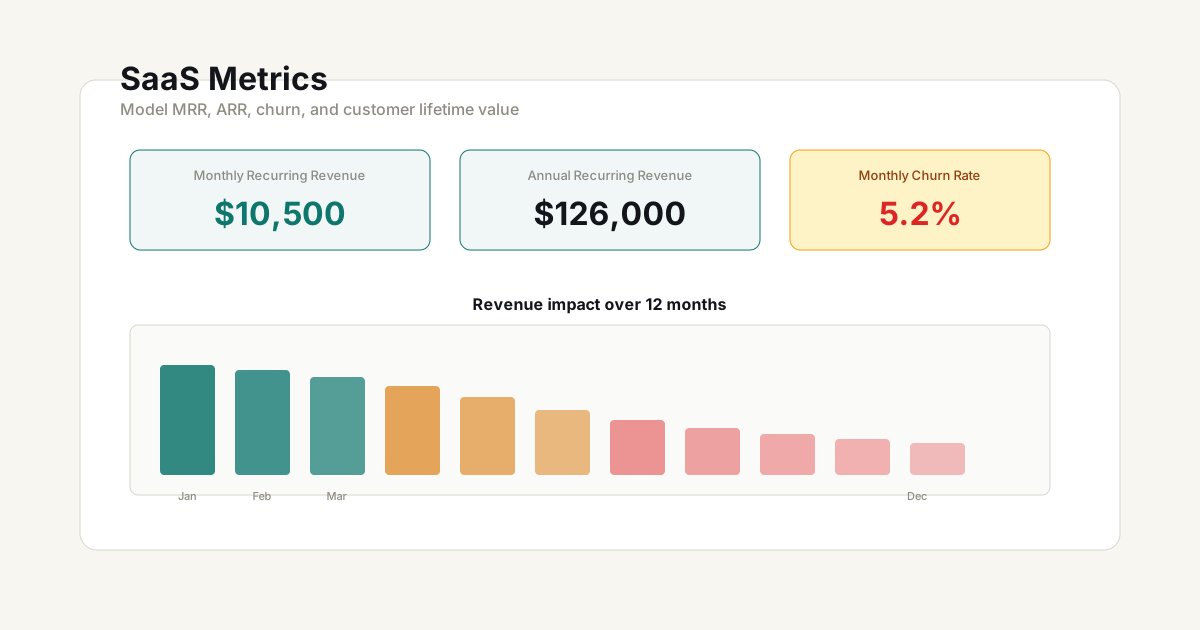
If you run a subscription business — SaaS, membership, newsletter — your revenue isn’t a single number. It’s a moving target shaped by new signups, upgrades, downgrades, and cancellations. Here’s how to model the key drivers.
MRR and ARR: the foundation
Monthly Recurring Revenue (MRR) is the lifeblood metric. It tells you how much predictable revenue you have each month. Annual Recurring Revenue (ARR) is simply MRR × 12.
Track MRR by tier. Most SaaS businesses have 2-3 pricing tiers, and the mix between them matters as much as the total:
- Your core plan is where most subscribers land — optimise pricing here
- A lower tier captures price-sensitive users but watch for cannibalisation
- A premium tier may have few subscribers but high margins
Use the SaaS Pricing Calculator to model MRR and ARR across up to 3 pricing tiers.
Churn: the silent killer
Churn is the percentage of revenue or customers you lose each month. It matters disproportionately because it compounds:
| Monthly churn | Annual revenue loss (at $10K MRR) |
|---|---|
| 3% | $3,600/year |
| 5% | $6,000/year |
| 8% | $9,600/year |
| 10% | $12,000/year |
Notice that cutting churn from 5% to 2.5% saves $3,000/year in this example — without adding a single new customer. That’s pure profit.
See exactly how churn impacts your business with the Churn Revenue Impact Calculator.
Customer lifetime value (LTV)
LTV answers a fundamental question: how much is each customer worth over their entire relationship with you? This determines how much you can afford to spend acquiring them.
The basic formula: LTV = (average purchase × frequency per year × customer lifespan) × gross margin
A healthy SaaS business has an LTV at least 3x its customer acquisition cost (CAC). Below 1x, you’re losing money on every customer.
| LTV/CAC ratio | Health |
|---|---|
| Below 1x | Losing money on every customer |
| 1x–3x | Marginal — needs improvement |
| 3x–5x | Healthy |
| 5x+ | Excellent |
Calculate your numbers: Customer Lifetime Value Calculator to see LTV and LTV/CAC ratio.
Putting it together
The most useful thing you can do is model all three metrics together:
- Current MRR tells you where you are
- Churn rate tells you how much leaks each month
- LTV tells you how much each customer is worth
- LTV/CAC tells you whether your acquisition spend is efficient
If churn is high, fixing it is usually more profitable than acquiring more customers. If LTV/CAC is below 3x, you need to either increase prices, reduce churn, or lower acquisition costs.
Run all the numbers: SaaS Pricing Calculator, Churn Revenue Impact Calculator, and Customer Lifetime Value Calculator.
Frequently Asked Questions
What's a healthy churn rate for a solo SaaS?
Under 5% monthly churn is good for early-stage solo SaaS; under 3% is excellent. Above 8% is a red flag that needs immediate investigation. Annual churn matters more than monthly — aim for under 15% annually once you have 12+ months of data.
How do I calculate LTV if I'm pre-revenue?
Use conservative industry benchmarks: assume $25-50 monthly ARPU and 12-24 month average customer lifespan for B2C SaaS. For B2B, double both numbers. These are placeholder estimates — replace with real data as soon as you have 3+ months of paying customers.
Is MRR or ARR more important for a solo founder?
MRR tells you about month-to-month health; ARR gives the bigger picture. For solo founders, MRR is more actionable because you can see the immediate impact of churn and new signups. Track both, but make daily/weekly decisions based on MRR trends.
Planning tools — Use the calculators and frameworks on this site to model scenarios and compare assumptions. Results are estimates, not financial, legal, or tax advice.